Environmental psychology, sensory design, and creative technology have all conducted extensive research on homesickness, spatial displacement, and sensory nostalgia in international students.
Institutional & Campaign efforts (e.g., HSBC’s Sounds of Home, 2019): To assist international students connect with their home countries, corporate campaigns and university well-being efforts sometimes incorporate auditory soundscapes (e.g., local markets, transit noise, native languages). Although these programs recognize sensory boundaries, they frequently provide passive, widely disseminated information (like as pre-recorded tracks) without involving players in active spatial creation.
Sensory and Olfactory Installations (e.g., CRASSH Scents & Imagination, 2025; RCA Olfactory Migration Projects): Olfaction as a sociocultural marker for identity, migration, and memory is the subject of recent practice-led creative study. Olfactory installations are used in projects like as Yati Sharma’s The Olfactory Dimension of Cultural Integration (Royal College of Art, 2024) to provoke memories of loss and spatial belonging among migrants. However, rather than being incorporated into participants’ private, residential spaces, these activities are mostly gallery-bound or curated in public exhibition contexts.
Studies on psychological and experimental emotions (such as PMC Food Nostalgia Studies and Oliver et al., 2024): Numerous studies have examined how nostalgia mitigates spatial anxiety and disorientation. To induce state nostalgia, these investigations often use standardized visual or olfactory stimuli in controlled laboratory settings.
How My Project Differs
This project presents a participative, practice-led design framework in contrast to traditional sensory campaigns that depend on single-medium products, passive gallery installations, or restorative nostalgia. The study involves overseas students as active co-creators in their own household micro-spaces by including a dual-sensory process that combines tactile transitional artifacts for instantaneous physical anchoring with olfactory cues to access memory. In the end, it moves the emphasis from passively yearning for home to actively fostering spatial belonging, emotional agency, and introspective nostalgia while residing abroad.
Following the refinement of my theoretical framework on homesickness and emotional comfort, I have officially launched the first wave of my research interventions!
The Design of the Intervention Six adults (all over the age of eighteen) have been enlisted to participate in a five-day sensory experiment called the “Micro-Comfort Zone Challenge.”
Instead of mailing complicated physical materials, I gave each participant a structured Sensory Challenge Card and instructed them to use their own personal belongings to create a modest, devoted “refuge” in their current living area.
Two main sensory channels are the focus of the task:
Tactile/Soft Elements: Adding tactile soothing and physical warmth by using stuffed animals, soft blankets, pillows, or other items.
Olfactory Elements: Including pleasant or familiar fragrances (e.g., room sprays, scented candles, beloved perfumes, or clothing with a unique personal scent).
For five days in a row, participants are instructed to gather these components into a specific nook (such as a rug, an armchair, or a corner of their bed) and spend ten to fifteen minutes a day interacting with this area while documenting their daily emotions, thoughts, and sensory reactions.
Theoretical Foundation and Hypothesis My latest literature review and useful design research are closely connected by this intervention:
Tactile Anchors (Transitional Objects): Plush toys frequently serve as transitional objects in developmental and clinical psychology (Winnicott, 1953). These tactile objects offer nonjudgmental consolation and physical anchoring to adult international students who are suffering spatial disorientation.
Olfactory Memory Activation: Fragrances skip cognitive filters and enter the limbic system directly, causing instantaneous emotional memories (the Proustian phenomena).
Psychological Agency: Participants exercise agency over their micro-environment by actively modifying their immediate surroundings to create a personal “safe zone,” so mitigating emotions of homesickness or spatial disorientation.
I’m interested to see how this five-day routine affects their sense of spatial belonging and emotional health.
Interview Guide for Post-Intervention I will conduct a semi-structured debriefing interview with each of the six participants for 15 to 20 minutes following the conclusion of the 5-day challenge.
We frequently refer to homesickness as just “missing home” or feeling a little alone. However, homesickness is described as a particular distress reaction brought on by real or imagined separation from one’s primary environment in traditional psychological literature (Fisher, 1989; Van Tilburg et al., 1996).
According to Fullilove’s (1996) application of Bowlby’s Attachment Theory to spatial contexts, homesickness results from the sudden disruption of our established “place attachments” and cultural anchor points. It is more than just a feeling; it appears as:
Constant, bothersome thoughts about familiar spatial, sensory, or social environments are known as cognitive preoccupation.
A brief lack of agency or familiarity in a foreign, unfamiliar setting is known as spatial disorientation.
More notably, cultural analyst Svetlana Boym (2001) splits nostalgia down into two categories:
Restorative Nostalgia: The longing to physically repair or return to the lost home.
Reflective Nostalgia: A meditative, creative engagement with distance, memory, and spatial longing.
For my project, I am focused on introspective nostalgia. Rather than trying to “fix” homesickness by literally sending individuals back, my interventions aim to provide a space where participants can reflect on their relationship with home using sensory cues.
References
Boym, S. (2001). The Future of Nostalgia. New York: Basic Books.
Fisher, S. (1989). Homesickness, Cognition, and Health. London: Lawrence Erlbaum Associates.
Fullilove, M. T. (1996). Psychiatric implications of displacement: Contributions from the psychology of place. American Journal of Psychiatry, 153(12), 1516-1523.
Van Tilburg, M. A., Vingerhoets, A. J., & Van Heck, G. L. (1996). Homesickness: A review of the literature. Psychological Medicine, 26(5), 899-912.
Refining Participant Demographics, Key Concepts, and Remote Interventions
I’ve reached a number of significant turning points in determining the course of my study and how to carry out my impending research interventions after a very beneficial tutorial with Zuleika.
Demographic Scope & Participant Ethics: Changing to 18+ Because the educational institution I am working with naturally operates within that age range, my project’s initial goal was to include participants who were 16 years of age or older. But our conversation about institutional compliance, ethics, and safeguarding made clear how difficult it is to work with children.
Involving under-18 volunteers necessitates lengthy approval procedures, including written agreement from Central Saint Martins (CSM) ethics committees and parents/guardians. I have formally chosen to change my target participation demographic to individuals 18 years of age and older in order to retain momentum and practical viability while upholding ethical integrity. This change enables me to keep a strong participant base while avoiding procedural bottlenecks and concentrating on the essential study outcomes.
Dissecting Fundamental Theoretical Ideas We also discussed the basic vocabulary supporting my project during the tutorial. In particular, we pointed out that important concepts like comfort and homesickness need a stronger, more precise academic foundation:
What exactly does homesickness mean? Beyond mere nostalgia, how does it appear in modern diaspora and design contexts?
What does comfort mean? Is it material, psychological, spatial, or sensory?
In the future, I will devote a concentrated literature analysis to providing an academic foundation for these ideas and dissecting the ways in which spatial nostalgia, olfactory triggers, and emotional comfort interact in design research.
Organizing the Remote Execution and Interventions I need to develop my practical action plan in addition to theoretical framing. Specifically, what is the structure and experience of my interventions?
I am currently unable to return to China as planned in order to conduct on-site fragrance explorations and obtain firsthand contextual references due to health issues. Although this causes a short-term delay in China’s actual field research, it has created an interesting new methodology: remote interventions.
I’m currently developing digital and remote engagement models that let people communicate, think, and share their sensory reactions while they’re far away. In addition to overcoming existing physical limitations, this pivot offers a useful testbed for the activation of emotional comfort and sensory memory across geographical boundaries.
The smell is the key to achieving the ideal balance for this endeavor. The idea is to investigate how various scents might evoke amazing memories in people. Everybody has a unique memory profile, though. One person’s sense of “home” may be quite different from another’s.
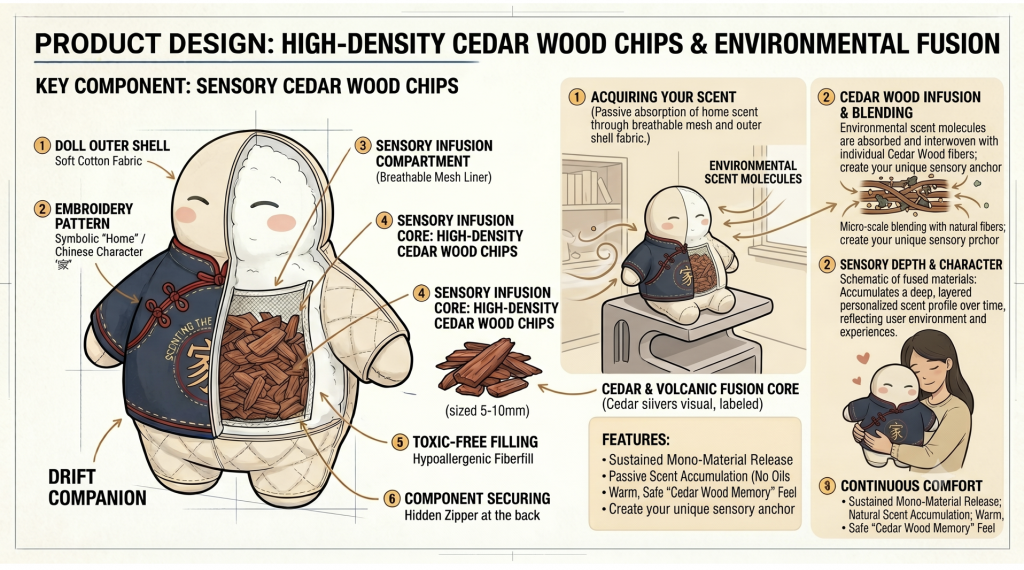
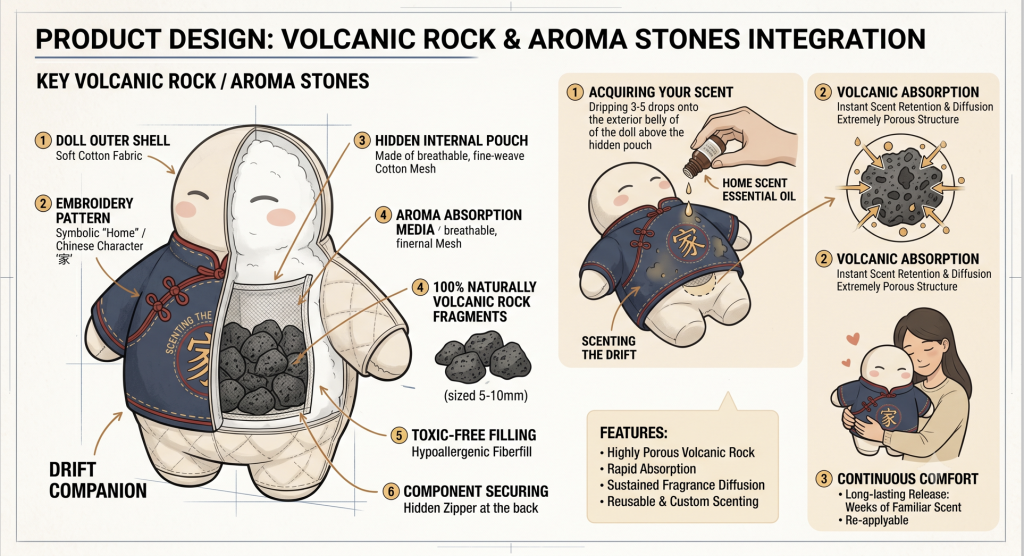
The next stage in addressing this is to investigate a variety of carefully chosen scents. The inquiry will concentrate on flexibility rather than a single fixed fragrance. The objective is to investigate whether it is possible to create a companion doll that allows users to effortlessly switch out scents according to their individual experiences.
Examining existing scent-retention technologies is necessary to achieve this. In particular, high-density cedar wood chips and volcanic rock will be tested. The goal is to assess how volcanic rock’s extremely porous nature may both quickly absorb and gradually release scents. Simultaneously, tests will be conducted to determine how cedar wood chips use natural fiber absorption to passively absorb scents from the surroundings while adding a delicate, warm, woodsy quality.
The goal of the research is to determine how the doll can develop into an evolving sensory anchor by experimenting with these materials. This approach maintains the research’s openness, personalization, and foundation in continuous material testing.
The project is being reset in accordance with the most recent tutorial input. The initial study question was overly specific and lengthy. Before the process even began, it assumed the answer. It is now simpler to concentrate on how Chinese living abroad might manage cultural displacement with the use of tactile and olfactory physical partners. The main concept investigates how ordinary smells might be passively absorbed by physical companions made of natural materials. As a result, abstract recollections of “home” become tangible. Hard data is becoming more important in order to demonstrate why people need this. We are now doing focus groups, interviews, and qualitative surveys with the real target audience. Looking at the market, the majority of the solutions available now are either traditional aromatherapy or digital apps.
This study is unique in that it focuses solely on the long-term storage of fragrance in a physical object. People will learn from this study how the Proust phenomenon might actually reduce the stress associated with migration. It demonstrates that a screen is not the only source of emotional solace. The emphasis is on ongoing testing loops rather than a perfect final result. Stakeholders will be able to directly influence the design through interactive workshops. Right now, it is vital to use sensory mapping to record every single test, observation, and quotation. To demonstrate how the project has changed, all of this new, data-driven preparation is being crammed into an organized presentation.
Relinquishing Premature Forms for Unrestricted Material Empathy
1. The Creative Setback & Critical Realization
I’ve reached a crucial turning point in my action research when I consider my original WHAT-WHY-HOW-IF structure and the insightful criticism I received during Monday’s presentation and tutorial. I came to see that my earlier approach fell victim to an epistemological trap: I was pushing my study too quickly to converge into a fixed aesthetic form (the particular fox/shiba-inu plush companion). Although actual first stakeholder talks and primary interviews gave rise to such concrete character, interpreting it as the final “outcome” was unintentionally eliminating countless possible paths. I was limiting the agency of the folks I wanted to empower by defining how homesickness should seem by establishing the sensory enclosure so early.
2. Interrogating the Research Question
This insight profoundly alters and improves my analysis of my main study question: How may Chinese populations that have been temporarily displaced find solace through tactile and olfactory familiarity? The object becomes a passive product for consumption rather than an active, specially constructed somatic anchor if I dictate how the physical companion should look. I must abandon my role as an authoritarian designer and take on the role of facilitator of an open experimental framework in order to fully comprehend the psychological variations in how “home” appears in people’s thoughts.
3. The Framework of Absolute Freedom
My approach will change from product design to systemic infrastructure design as I continue my summer fieldwork around China. Any predetermined visual storylines are being eliminated. Rather, my next interventions with the extended pre-departure cohorts and the Shenzhen Foreign Language School International Department (SWIS) network will function under just two essential, non-negotiable boundaries:
A calming touch.
A scent trigger that brings back memories of home.
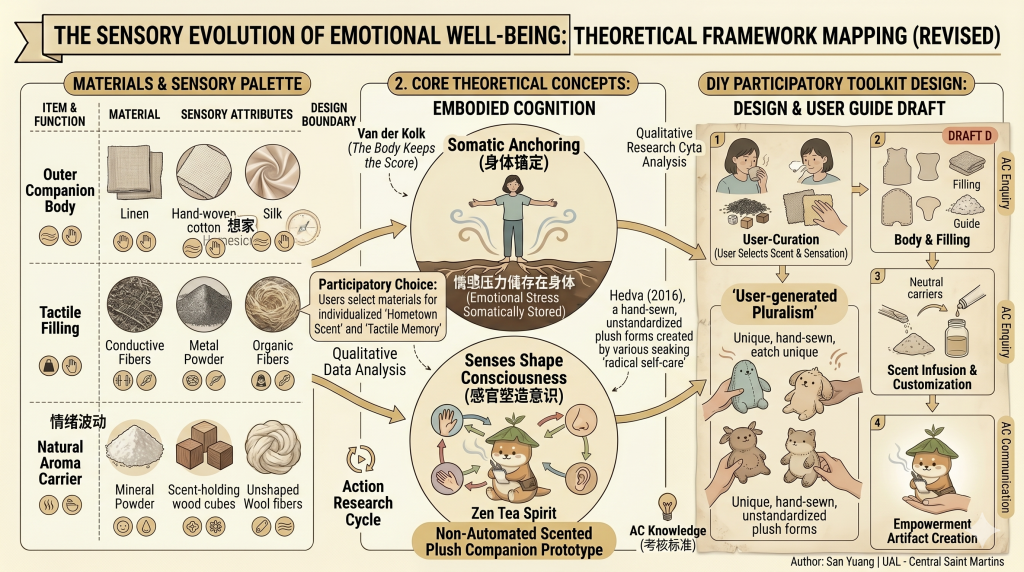
Participants will have complete flexibility within this dual-boundary perimeter. I’ll provide a blank canvas filled with unshaped elements, including neutral scented carriers, different weights of fillings, and raw textiles.
4. Expected New Knowledge & Future Impact
I will collect rich, primary qualitative data on cognitive and emotional diversity by recording how various people naturally shape, compress, weigh, and infuse these materials based only on their inner desires.
This innovative change turns my project into a participatory repository of user-generated pluralism rather than a single therapeutic novelty. It demonstrates that genuine emotional health and a feeling of community cannot be mass-standardized; instead, they must be independently formed by unpredictable, unprocessed human memory.
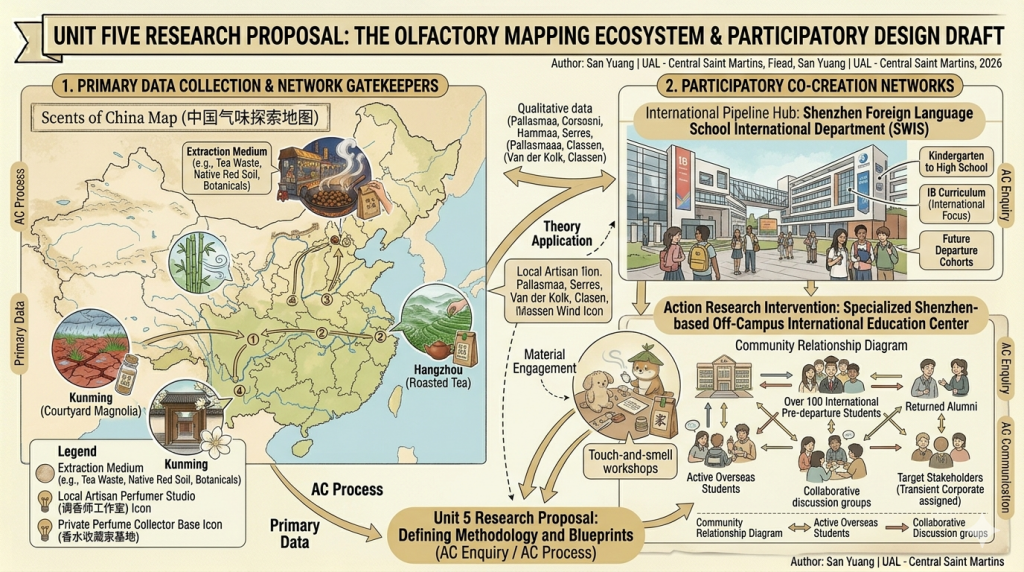
In order to examine how non-automated sensory anchors reduce emotional precarity among transient Chinese populations, this study creates a multi-layered participative and somatic network. Beyond general stakeholder mapping, this network particularly connects industrial production, regional scent extraction, and international education pipelines to create a mutually beneficial action-research ecosystem.
(a) Existing Networks and Gatekeepers
A highly focused pre-departure and post-return student network serves as the foundation for the primary data gathering. I work with the Shenzhen Foreign Language School International Department (SWIS), which administers the IB curriculum for children in kindergarten through high school, as well as a specialized off-campus international education facility in Shenzhen that houses more than 100 students from prestigious international schools. This network is an essential place for incubation. Students getting ready to leave, current international students, and returning alumni are the main forces behind this. For the purpose of testing localized sensory displacement, they are the perfect active actors. These cohorts will take part in touch-and-smell workshops to externalize their subjective emotional alignment both before and after relocation, using my open-ended experimental framework (unrestricted freedom limited only by tactile calming and homeland aroma).
(b) Emergent Networks and Co-curators
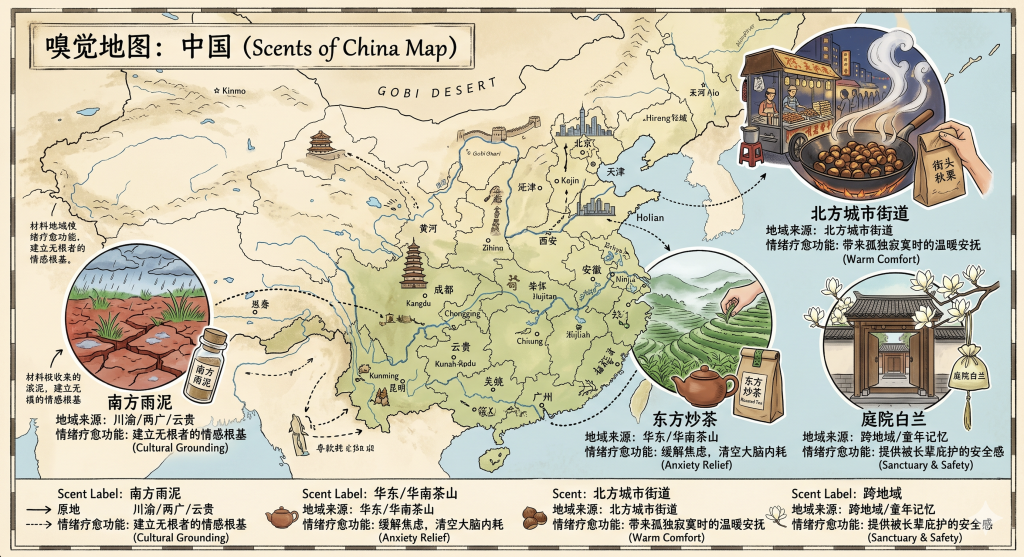
In order to document the material and geographic aspects of the “smell of home,” I am extending my network across China’s summer across four different geopolitical quadrants. In this field study, human actors give way to non-human, natural actors (such as native organic soil, Eastern roasted tea, and local botanicals). To standardize extraction techniques, I will work closely with regional botanical distillers and artisan perfumers. Additionally, in order to critically examine the ideological distinctions between intimate, nostalgic cultural scents and generic commercial scents, I will engage with well-known private perfume collectors in China. This closes the gap between highly personal psychological archiving and mass sensory production.
(c) Plan for Engagement and Transformation
The network’s last node links research to industry execution in order to convert these sensory insights into tangible objects. I am collaborating with a senior scent designer with experience in industrial design and an agile product design firm. I offer a validated somatic framework based on the theories of Classen and Van der Kolk, as well as empirical qualitative data from more than 100 foreign applicants. Because user-shattered designs are very unpredictable and structurally fragile, industrial producers may first operate as a “restraining” force; but, our collaborative iteration will build an adaptive toolbox. In the end, this network makes it possible for decentralized, user-led emotional empowerment to replace inflexible designer-led manufacturing.
Bibliography
Classen, C. (1993) Worlds of sense: exploring the senses in history and across cultures. London: Routledge.
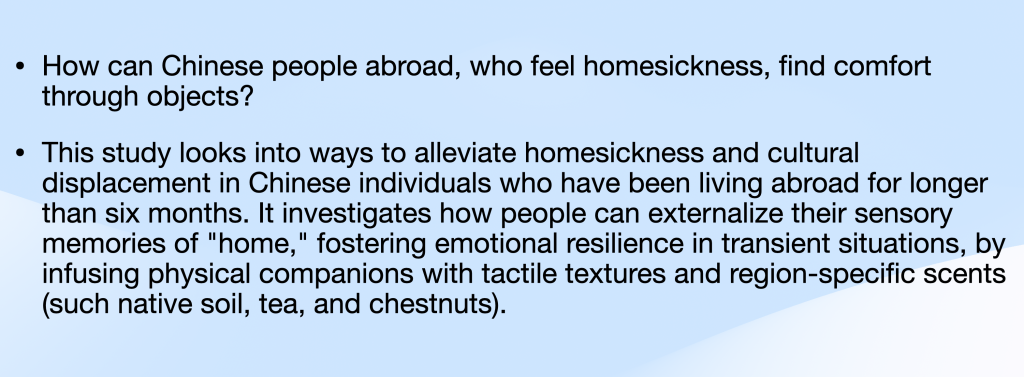
This study investigates how material, physical treatments can lessen emotional precocity in people who are emotionally spent and temporarily relocated. It explicitly addresses the following research question: How can Chinese people abroad (for longer than 6 months), who feel homesickness, find comfort through objects that provide familiarity, tactile and olfactory memories? The target stakeholders are precisely defined as international professionals and students who have moved for temporary corporate assignments rather than permanent immigration. Among the key concepts are somatic anchoring, olfactory cultural legacy, temporary well-being, and functional sensory design. The primary objective is to produce non-electronic, scented plush companions that serve as physical links to the users’ home countries by incorporating human-curated regional scents, such as local teas or native soil. This is predicated on the empiricist philosophy of Serres (2016), which maintains that bodily senses shape human consciousness.
WHY
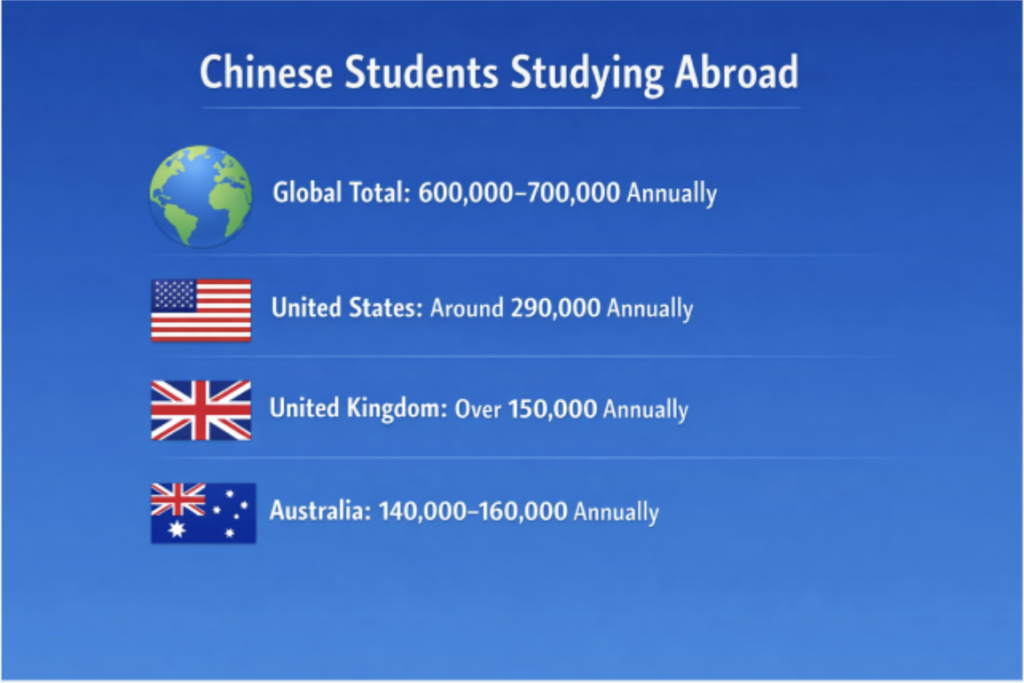
I am motivated both personally and professionally by the widespread temporary international mobility for education and career advancement, which leaves people in a prolonged state of emotional “drifting.” Every year, between 600,000 and 700,000 Chinese professionals and students go abroad, experiencing severe yet transient cultural isolation. This research is crucial since the well-being support that is now provided in academic institutions and business settings is often overly clinical or distant from real-world situations. By highlighting the neglected senses of touch and smell, this concept provides a tactile, sympathetic alternative. According to Classen’s (1993) anthropology of odor, it demonstrates that the “smell of home” is a key sign of cultural identity too precious and sensitive to be automated, supporting human-to-human connection over industrial standardization.
HOW
The method is framed under “Action Research” through cycles of qualitative, iterative inquiry that support co-creation by participants. This study creates an open-ended experimental framework that allows people complete creative freedom under only two non-negotiable boundaries: a calming tactile feel and a scent that evokes memories of home, moving away from strict, designer-led prototyping. In practical terms, my current action cycle converts this theory into open-source courses and a participative toolbox. I provide consumers a blank canvas of raw materials (different unshaped textiles, conductive fillers, and neutral carriers) rather than imposing a predetermined style, like my original utilitarian phone-grip buddy. Participants are invited to externalize their own subjective displacement through touch-and-smell workshops held inside global academic and professional networks. These seminars serve as forums for discussion, guided by Van der Kolk’s (2014) thesis on the somatic storage of emotional stress. The study analyzes the wide ideological and psychological differences in how “home” is uniquely expressed through human memory by documenting how various people naturally shape, weigh, and infuse these elements.
WHAT-IF
If successful, this research creates a decentralized archive of various, self-soothing artifacts by replacing standardized items with user-generated pluralism for emotional support. Giving participants complete autonomy, however, would result in extremely unpredictable consequences; some products might be too deeply subjective for anybody but the maker to comprehend, structurally brittle, or practically impracticable. In the end, our study shows that true well-being is attained through an open framework that permits the unanticipated variability of raw sensory memory to retake its position at the core of human connection rather than through uniform technology.
Bibliography
Classen, C. (1993) Worlds of sense: exploring the senses in history and across cultures. London: Routledge.
Drobnick, J. (ed.) (2006) The smell culture reader. Oxford: Berg.
My research is based on a very personal observation I made about the emotional struggles faced by young professionals and international students who live away from home. Many people, like myself, are “drifting”—managing life in distant locations while harboring a deep, even agonizing longing for their origins. The “area of change” is, in my opinion, how we offer this displaced population emotional support. Nowadays, a lot of mental health tools are digital or clinical. I suggest a change to human-centered, sensory-based therapies that use touch and aroma to create a connection between a distant home and a foreign space.
The Concept: Scented Plush Companions
The development of scented plush friends is the change I wish to implement. These are more than just toys; they are “sensory anchors” that preserve the distinct scent of a person’s own country. According to research, the sense most strongly associated with emotion and memory is smell. I want to provide users a concrete link to their past by infusing dolls with fragrances that symbolize particular national or regional backgrounds, such as the aroma of particular tea kinds, native flowers, or spices. The goal of this intervention is to create a haven of comfortable familiarity in the “unknown” and “intimidating” areas of a strange city.
Integrating Theoretical Frameworks
A variety of theoretical stances have influenced my path to this conclusion. I use Van der Kolk’s (2014) explanation that the body “keeps the score” of emotional stress in order to comprehend the physical weight of homesickness and worry. In times of extreme anxiety, a tangible, weighted doll offers the tactile anchoring required to calm the nervous system. In addition, I use Johanna Hedva’s (2015) Sick Woman Theory to support the vulnerability of people who are lost in a very competitive metropolitan environment. This project promotes a type of “radical self-care” for both workers and students, recognizing that their yearning for home is a real need that merits a committed, sensory-rich solution.
Stakeholders and Engagement
Using Freeman’s (2010) Stakeholder Theory, I have determined that this shift requires cooperation between the “drifters” (users), scent experts who can select genuine local scents, and universities like UAL that host international populations. Accurately capturing the “essence” of a home while eschewing preconceptions and concentrating on genuine cultural indicators is the difficult part. In order to make sure that the design is driven by human experience rather than technology convenience, I plan to start conversations with my peers to find out which particular scents make them feel like they belong.
Personal Reflection and Future Goals
This project pushes me to step outside of my comfort zone by fusing cultural psychology with product design. Realizing that the most potent “change” I can effect is not through intricate procedures but rather through a straightforward, fragrant item that conveys the message, “You are not alone; your home is still with you,” has been a life-changing experience. I want to work on this topic for my MA since it combines my technical research abilities with a very humane goal: using memory and touch to alleviate the loneliness of the displaced.
References
Freeman, R. E. (2010) Stakeholder Theory: The State of the Art. Cambridge: Cambridge University Press.