The Olfactory Mapping Ecosystem
Introduction & Rationale
In order to examine how non-automated sensory anchors reduce emotional precarity among transient Chinese populations, this study creates a multi-layered participative and somatic network. Beyond general stakeholder mapping, this network particularly connects industrial production, regional scent extraction, and international education pipelines to create a mutually beneficial action-research ecosystem.
(a) Existing Networks and Gatekeepers
A highly focused pre-departure and post-return student network serves as the foundation for the primary data gathering. I work with the Shenzhen Foreign Language School International Department (SWIS), which administers the IB curriculum for children in kindergarten through high school, as well as a specialized off-campus international education facility in Shenzhen that houses more than 100 students from prestigious international schools. This network is an essential place for incubation. Students getting ready to leave, current international students, and returning alumni are the main forces behind this. For the purpose of testing localized sensory displacement, they are the perfect active actors. These cohorts will take part in touch-and-smell workshops to externalize their subjective emotional alignment both before and after relocation, using my open-ended experimental framework (unrestricted freedom limited only by tactile calming and homeland aroma).
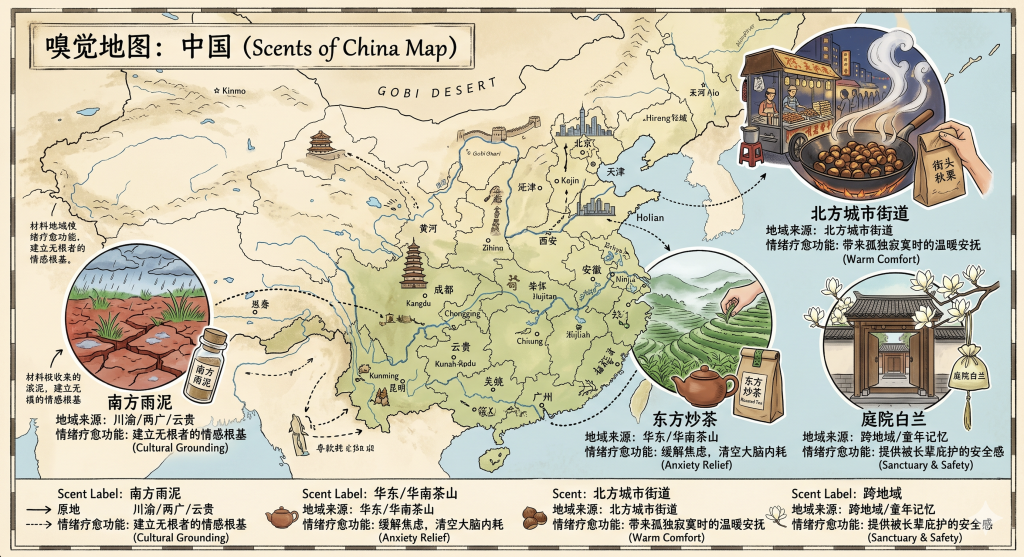
(b) Emergent Networks and Co-curators
In order to document the material and geographic aspects of the “smell of home,” I am extending my network across China’s summer across four different geopolitical quadrants. In this field study, human actors give way to non-human, natural actors (such as native organic soil, Eastern roasted tea, and local botanicals). To standardize extraction techniques, I will work closely with regional botanical distillers and artisan perfumers. Additionally, in order to critically examine the ideological distinctions between intimate, nostalgic cultural scents and generic commercial scents, I will engage with well-known private perfume collectors in China. This closes the gap between highly personal psychological archiving and mass sensory production.
(c) Plan for Engagement and Transformation
The network’s last node links research to industry execution in order to convert these sensory insights into tangible objects. I am collaborating with a senior scent designer with experience in industrial design and an agile product design firm. I offer a validated somatic framework based on the theories of Classen and Van der Kolk, as well as empirical qualitative data from more than 100 foreign applicants. Because user-shattered designs are very unpredictable and structurally fragile, industrial producers may first operate as a “restraining” force; but, our collaborative iteration will build an adaptive toolbox. In the end, this network makes it possible for decentralized, user-led emotional empowerment to replace inflexible designer-led manufacturing.
Bibliography
Classen, C. (1993) Worlds of sense: exploring the senses in history and across cultures. London: Routledge.
Hedva, J. (2016) ‘Sick Woman Theory’, Mask Magazine, (January). Available at: http://www.maskmagazine.com/not-again/struggle/sick-woman-theory (Accessed: 21 May 2026).
Serres, M. (2016) The five senses: a philosophy of mingled bodies. Translated by M. Sankey and P. Cowley. London: Bloomsbury Academic.
Van der Kolk, B.A. (2014) The body keeps the score: brain, mind, and body in the healing of trauma. New York: Viking.
Leave a Reply