(WHAT-WHY-HOW-WHAT IF)
WHAT
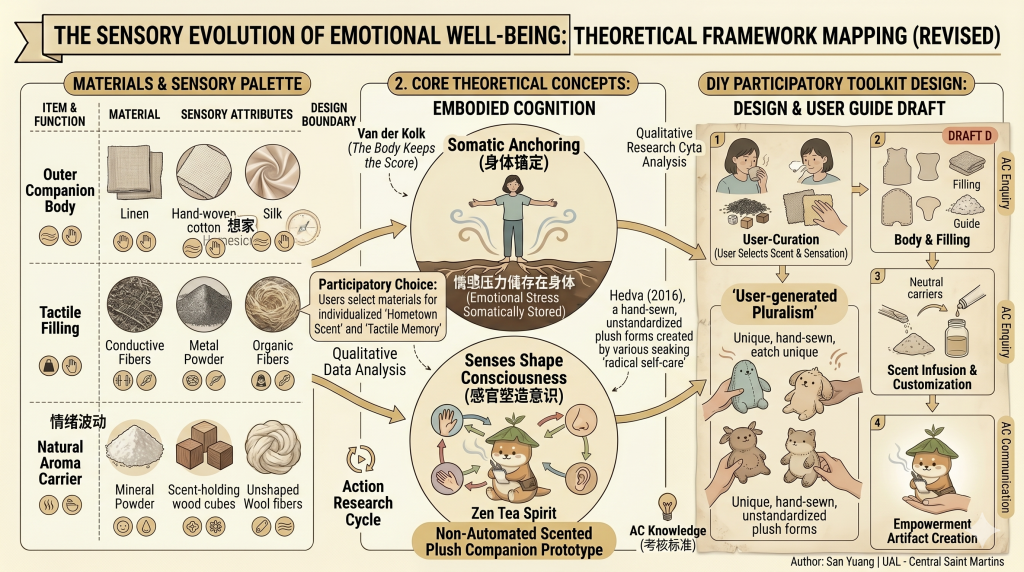
This study investigates how material, physical treatments can lessen emotional precocity in people who are emotionally spent and temporarily relocated. It explicitly addresses the following research question: How can Chinese people abroad (for longer than 6 months), who feel homesickness, find comfort through objects that provide familiarity, tactile and olfactory memories? The target stakeholders are precisely defined as international professionals and students who have moved for temporary corporate assignments rather than permanent immigration. Among the key concepts are somatic anchoring, olfactory cultural legacy, temporary well-being, and functional sensory design. The primary objective is to produce non-electronic, scented plush companions that serve as physical links to the users’ home countries by incorporating human-curated regional scents, such as local teas or native soil. This is predicated on the empiricist philosophy of Serres (2016), which maintains that bodily senses shape human consciousness.
WHY
I am motivated both personally and professionally by the widespread temporary international mobility for education and career advancement, which leaves people in a prolonged state of emotional “drifting.” Every year, between 600,000 and 700,000 Chinese professionals and students go abroad, experiencing severe yet transient cultural isolation. This research is crucial since the well-being support that is now provided in academic institutions and business settings is often overly clinical or distant from real-world situations. By highlighting the neglected senses of touch and smell, this concept provides a tactile, sympathetic alternative. According to Classen’s (1993) anthropology of odor, it demonstrates that the “smell of home” is a key sign of cultural identity too precious and sensitive to be automated, supporting human-to-human connection over industrial standardization.
HOW
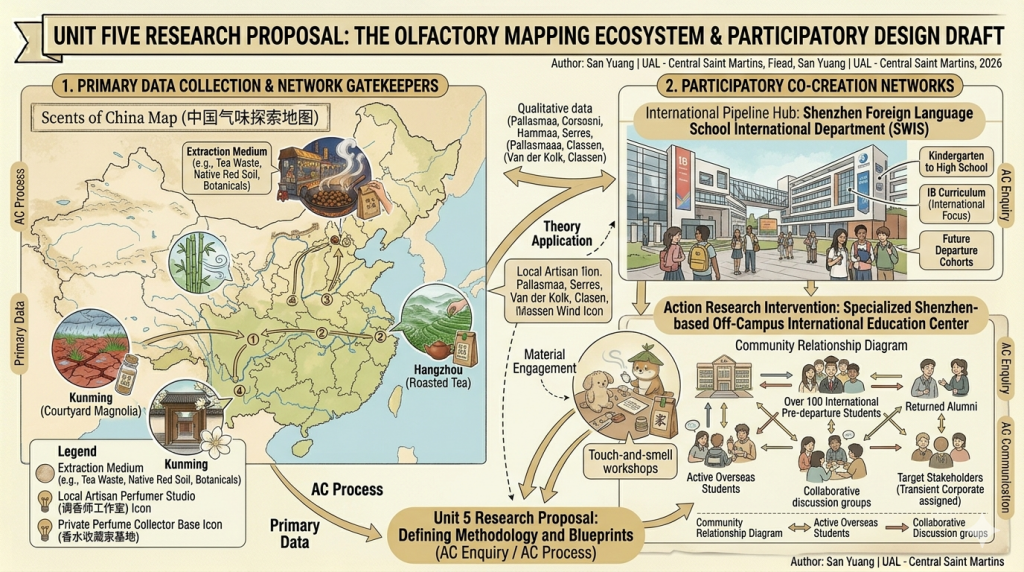
The method is framed under “Action Research” through cycles of qualitative, iterative inquiry that support co-creation by participants. This study creates an open-ended experimental framework that allows people complete creative freedom under only two non-negotiable boundaries: a calming tactile feel and a scent that evokes memories of home, moving away from strict, designer-led prototyping. In practical terms, my current action cycle converts this theory into open-source courses and a participative toolbox. I provide consumers a blank canvas of raw materials (different unshaped textiles, conductive fillers, and neutral carriers) rather than imposing a predetermined style, like my original utilitarian phone-grip buddy. Participants are invited to externalize their own subjective displacement through touch-and-smell workshops held inside global academic and professional networks. These seminars serve as forums for discussion, guided by Van der Kolk’s (2014) thesis on the somatic storage of emotional stress. The study analyzes the wide ideological and psychological differences in how “home” is uniquely expressed through human memory by documenting how various people naturally shape, weigh, and infuse these elements.
WHAT-IF
If successful, this research creates a decentralized archive of various, self-soothing artifacts by replacing standardized items with user-generated pluralism for emotional support. Giving participants complete autonomy, however, would result in extremely unpredictable consequences; some products might be too deeply subjective for anybody but the maker to comprehend, structurally brittle, or practically impracticable. In the end, our study shows that true well-being is attained through an open framework that permits the unanticipated variability of raw sensory memory to retake its position at the core of human connection rather than through uniform technology.
Bibliography
Classen, C. (1993) Worlds of sense: exploring the senses in history and across cultures. London: Routledge.
Drobnick, J. (ed.) (2006) The smell culture reader. Oxford: Berg.
Hedva, J. (2016) ‘Sick Woman Theory’, Mask Magazine, (2016年1月). Available at: http://www.maskmagazine.com/not-again/struggle/sick-woman-theory (Accessed: 21 May 2026).
Malafouris, L. (2013) How things shape the mind: a theory of material engagement. Cambridge, MA: MIT Press.
Pallasmaa, J. (2012) The eyes of the skin: architecture and the senses. 3rd edn. Chichester: John Wiley & Sons.
Sanders, E.B.N. and Stappers, P.J. (2008) ‘Co-creation and the new landscapes of design’, CoDesign, 4(1), pp. 5–18.
Serres, M. (2016) The five senses: a philosophy of mingled bodies. Translated by M. Sankey and P. Cowley. London: Bloomsbury Academic.
Van der Kolk, B.A. (2014) The body keeps the score: brain, mind, and body in the healing of trauma. New York: Viking.
Leave a Reply